
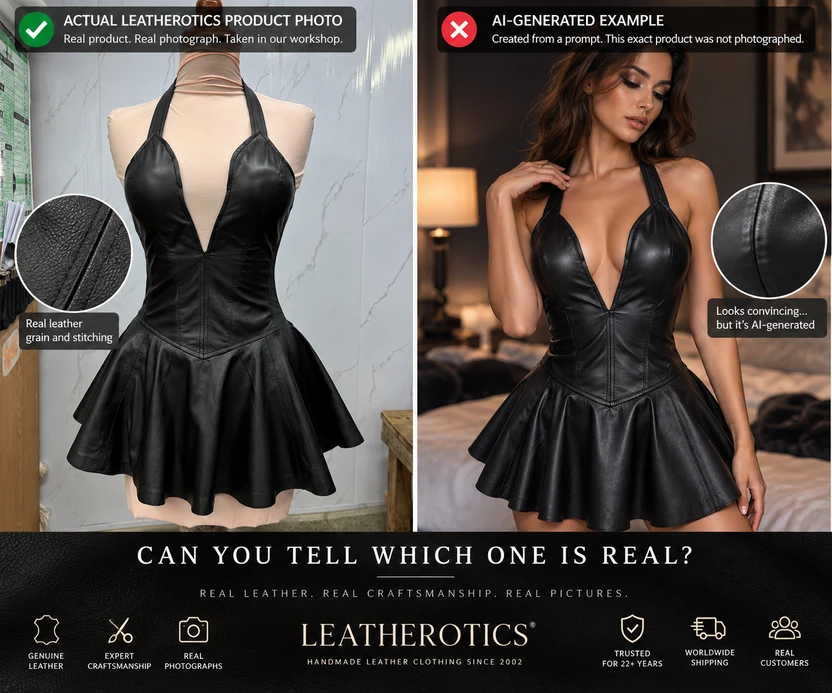
Real Product Photos vs AI Images: What Are You Actually Buying Online?
Posted by Leatherotics Journal on 16th Sep 2026
Something has changed in online shopping.
We've been producing leather clothing for over 22 years, and during that time we've seen eBay, Amazon, Etsy, dropshipping, copied photographs and cheap synthetic materials being advertised as leather.
But what we're seeing now is different.
AI can create an incredibly convincing image of a leather jacket, corset, dress or coat in seconds. The problem? The product in that photograph may never have existed.
And we think shoppers need to start talking about it.
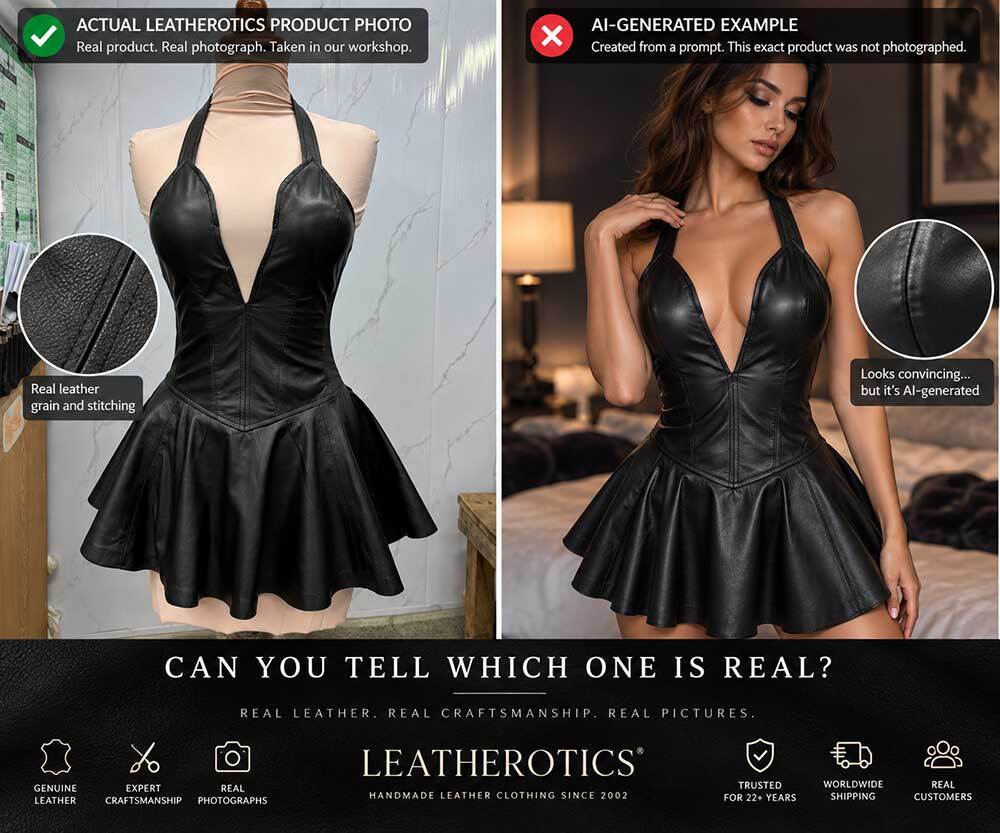
A real Leatherotics product photograph beside a clearly labelled AI-generated lifestyle example. The point is simple: a convincing image is no longer proof that the pictured product was physically photographed.
The photograph can now exist before the product
Traditionally, clothing followed a simple path: Design it - make a sample - check the fit - finish the product - photograph it - sell it.
AI makes another process possible: Generate an image - advertise it - take an order - then work out how to make it.
That's not quite the same as traditional dropshipping. With dropshipping, there's normally already a physical product somewhere in a supplier's catalogue. Today, somebody can potentially create anentire collection of impressive-looking fashion images without producing the garments first.
If somebody orders one, the seller can then try to find a manufacturer capable of making something that resembles the picture.
Will what arrives actually look like what you ordered? |
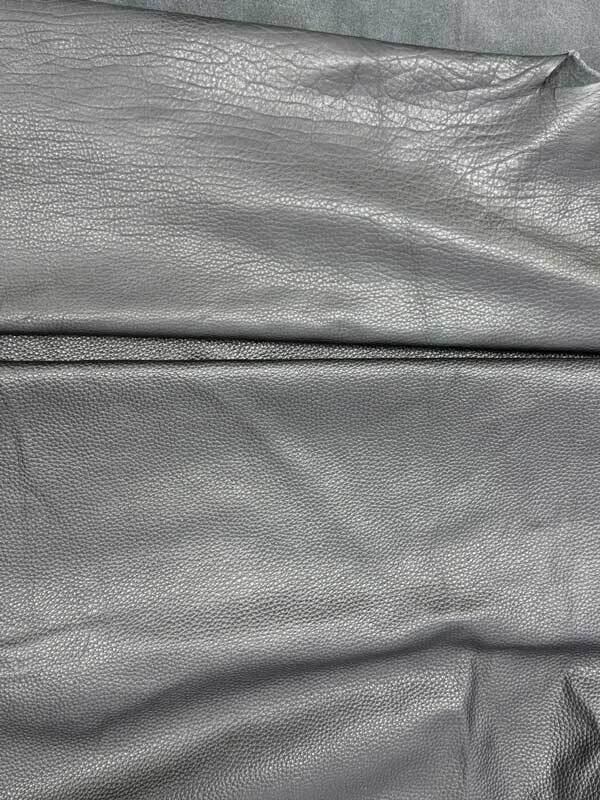
This is where our products start - real leather, not a generated leather texture.
We're not against AI
AI itself isn't the problem. There's nothing wrong with technology helping businesses with photography, design ideas or editing. We adjust lighting and colour in our own photographs when necessary so the leather looks as close as possible on screen to how it looks in person.
But there's an important difference between editing a photograph of a real product and generating a photograph of a product that was never actually photographed.
The garment in our photographs exists. That's the distinction that matters.
So how can you tell what's real?
Unfortunately, there's no magic test anymore. AI is getting better very quickly. But when you're looking at a leather garment online, there are still some simple things worth checking.
Look for several photographs of exactly the same product. Front, back, side and detail photographs should all agree. Count the buttons. Follow the seams. Look at where pockets, zips and buckles are positioned. Does everything stay in the same place?
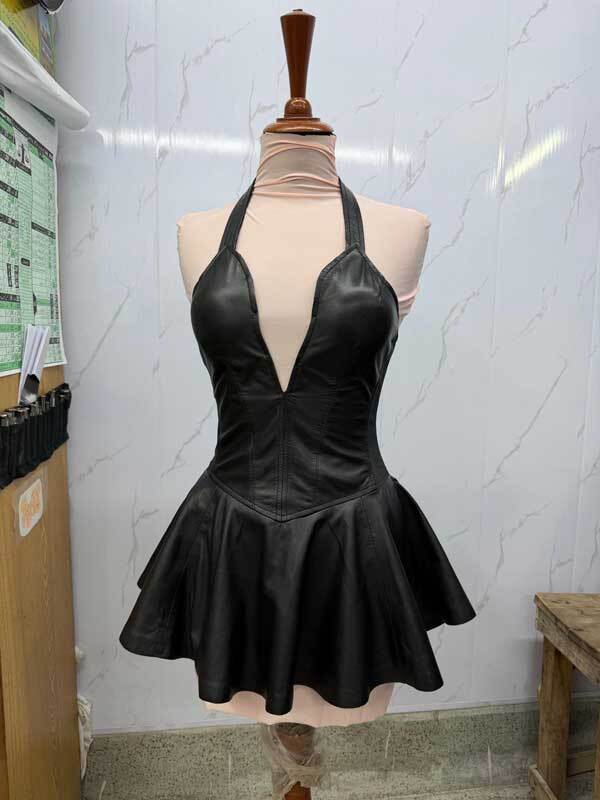
A real Leatherotics garment in our workshop. Made first. Photographed afterwards.
Leather is particularly useful here because it contains lots of physical detail. Look closely at the grain, stitching, eyelets, press studs, buckles, zips and seams.
A buckle has to function. A zip has to go somewhere. A seam has to continue around the garment. Lacing needs to pass logically through its eyelets.
Don't just ask, "Does this look beautiful?" Ask: "Could this actually be made like this?" |
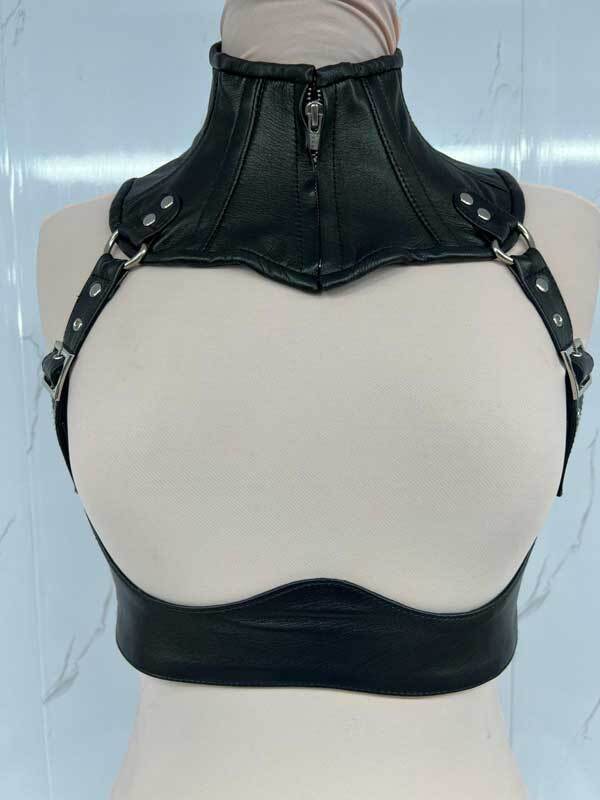
Real leather, stitching and hardware. Zoom in - genuine construction has physical logic.
Don't rely on a perfect picture
A beautiful photograph isn't proof anymore. Instead, look for evidence around the photograph. Does the seller show different angles? Are there close-ups or videos? Can you see the inside or lining? Do customer photographs show the same garment? Does the description actually tell you what type of leather you're buying? Is there a proper returns policy and an established history?
One strange detail doesn't automatically mean an image is AI-generated. But when several things don't add up, it's worth looking more carefully.
Reverse-image search isn't enough either
Google Lens and other reverse-image searches are still useful. If exactly the same “exclusive handmade jacket” appears on ten unrelated websites, you've learned something useful.
But a generated image can be completely new, meaning there may be nothing for a reverse-image search to find. So “no results found” doesn't necessarily mean the photograph is genuine.
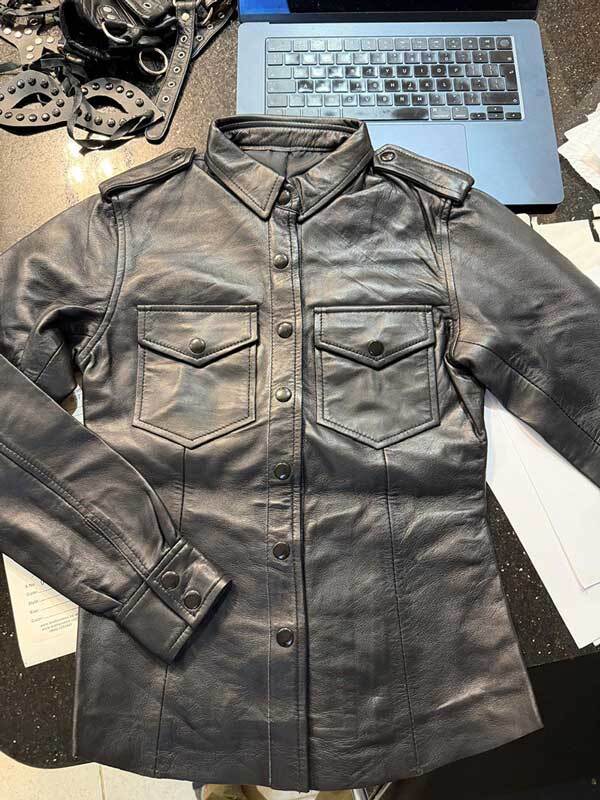
No virtual showroom needed. A finished Leatherotics leather garment photographed where we actually work.
Look beyond the website
This is probably more important than trying to become an AI-image detective. Anyone can build an impressive-looking website. Instead, look for evidence of the business behind it.
How long has it been trading? Does it consistently show real products? Are there genuine customer reviews? Can you see products from different angles and across different years? Does the company understand the materials and construction it's talking about?
When you're buying genuine leather, ask basic questions: What leather is it - lambskin, cowhide or goatskin? A genuine manufacturer or knowledgeable leather retailer should be able to answer.
What are marketplaces doing?
Marketplace rules are evolving as AI becomes more common. Etsy's Creativity Standards distinguish between seller-made physical products, seller-designed products made with production partners, and seller-prompted AI creations. For physical items classified as made by a seller, Etsy requires original photo or video content of the final product and also requires production partners to be disclosed in relevant circumstances.
Amazon has also introduced disclosure requirements concerning certain photorealistic AI-generated people appearing in listing images and video.
Rules will continue changing. But shoppers don't need to wait for every marketplace to develop the perfect policy. There are things we can all check ourselves.
Our approach at Leatherotics is simple
We've been producing leather garments for over 22 years. We make the physical product and then we photograph it.
Sometimes that photograph isn't perfect. You might see a workshop table, a mannequin, a laptop in the background, a crease in the leather, or other products we're working on sitting nearby.
And we're increasingly comfortable with that, because those little imperfections tell part of the story.
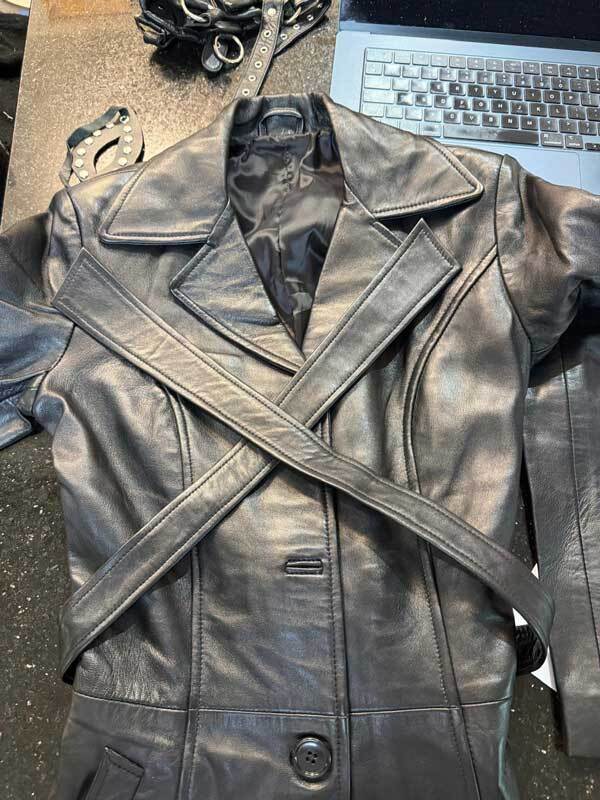
Not generated. Not imagined. A real leather garment sitting on our workbench.
We would rather show you something that actually exists than show you an impossibly perfect version of something that doesn't.
AI will continue getting better. So perhaps the better question isn't "Can I spot the AI?" Maybe it's:
Can the seller show me the real product? |
That's a question every genuine manufacturer should be happy to answer.
REAL LEATHER. REAL CRAFTSMANSHIP. REAL PICTURES.
What you see is what we make.
After more than 22 years working with leather, that's a promise we're happy to put our name behind.
Leatherotics
A quick way to check
No single detail proves anything on its own, but a few things are worth looking at together. Does the hardware behave the way real hardware has to? A buckle should close, a zip should go somewhere, lacing should pass logically through every eyelet. Does the same garment look like the same garment from every angle? Front, back, side and close-up should all agree with each other. Does the grain hold up under a closer look? Real leather has small, uneven, physical detail that's hard to fake and easy to check.
If in doubt, ask the seller to show you the product, not another picture of it. |
A few questions people ask us
How can I tell if a photo is AI-generated? No single clue is proof by itself. Check whether the hardware behaves logically, whether the garment stays consistent across every angle, and whether the grain looks like something with real, uneven texture rather than a smooth, generated surface. When several of these agree, that tells you something real.
Is an AI-edited photo the same as an AI-generated one? No. Adjusting the colour or lighting on a photograph of a real product is normal, honest photography, the kind most serious sellers already do Generating an image of a product that was never made is a different thing entirely, even though both can look equally polished on screen.
Are Leatherotics' own product photos real? Yes. Every photograph on our site is of a garment we made ourselves, in the workshop we work in every day. We tune the lighting so the leather reads true on screen, but we don't generate what isn't there.
What should I do if a listing still feels off? Ask the seller to show you the product itself, not another picture of it. A close-up, a different angle on request, or a straight answer about the leather usually tells you more than the listing photos ever will.
If you'd like to see what any of this looks like in practice, our women's leather corsets, men's boned corsets and leather dresses are photographed exactly the way we've described here: made first, worn afterwards, photographed in the workshop, creases and all.